 IELTS
IELTS Study Plan for 1–3 Months
Build a realistic one-, two- or three-month IELTS study plan with diagnostic practice, feedback and timed mock tests.
Read guide →IELTS Academic is generally used for higher education, while IELTS General Training is required for some employment and migration purposes. Both tests assess four skills, but the Reading and Writing papers differ. Check the requirements of the organisation you are applying to before choosing a test.
At a glance
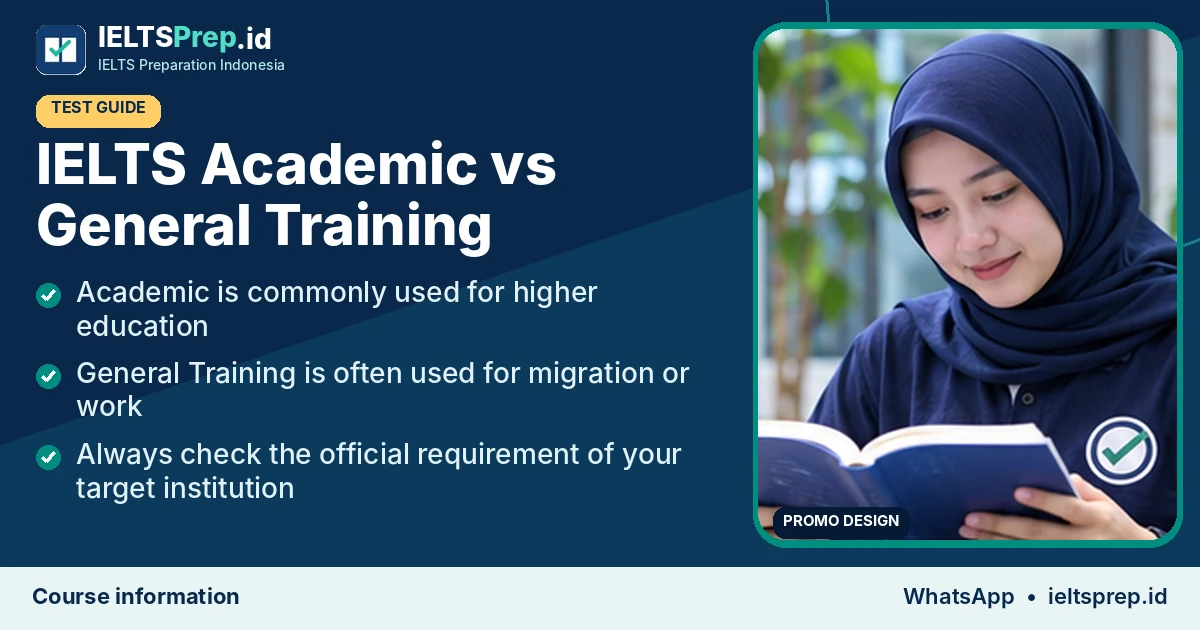
The main differences concern the intended use of the result and the Reading and Writing formats. Check institutional requirements before choosing.
Academic is commonly used for higher education and some professional registration. Its Reading and Writing sections use academic contexts.
General Training is used for some migration, employment and training needs. Reading and Writing involve social and workplace contexts. Both test types have the same Listening and Speaking formats.
Accepted test types and minimum scores differ between institutions. Before paying for preparation or booking the exam, check the accepted test type, minimum overall and component scores, and deadline. Consult the official IELTS test types.
Academic Reading uses texts suited to academic contexts. General Training Reading includes everyday and workplace material. In Writing Task 1, Academic candidates describe visual information, while General Training candidates write a letter. Both Task 2 formats require a written response to a topic.
If your university requires IELTS Academic, prepare using Academic materials. For WHV or migration, check the relevant country and visa category rather than automatically choosing General Training. For UKVI purposes, check whether a specific test or delivery arrangement is required.
Official references: IELTS Academic and IELTS General Training.
The purpose of your test determines which reading passages and writing tasks you should practise. Do not use every Academic exercise for General Training without checking the format. Instead, use materials for your chosen test when assessing exam readiness.
For Academic Reading, get used to texts containing more complex information and arguments. Learn to identify main ideas, supporting evidence and links between paragraphs. General Training Reading, by contrast, involves texts about daily life and work.
For Academic IELTS, practise objectively describing visual information in your own words. Start by identifying the most important trends, comparisons or stages. Then organise an explanation that is easy to follow without adding information absent from the visual.
For General Training, Task 1 focuses on communication through a letter. Consider its purpose, your relationship with the recipient and the appropriate level of formality. Make sure your answer covers every point in the task instructions.
Task 2 asks you to develop a written response to a topic. Practise presenting an opinion, reasons and relevant examples. Check the connections between ideas and avoid arguments that do not answer the main question.
Both test types use the same Listening and Speaking formats. You can therefore develop audio comprehension and spoken responses without separating all your materials. However, practice must still follow IELTS formats and assessment criteria.
For Listening, record why you make mistakes, such as missing keywords or misunderstanding paraphrases. In Speaking, practise spontaneous answers with clear reasons and examples. Review recordings to identify fluency or pronunciation problems.
Universities may set different requirements, and different visa categories may require specific evidence of English ability. Confirm requirements directly with the relevant institution or authority.
If you are unsure, do not pay the exam fee yet. Make a list of requirements, ask which test is accepted and keep the official response. Then choose suitable preparation materials and build an IELTS study plan around your deadline.
Choose a class that fits your starting level and schedule. Compare learning formats before registering.
Continue with a guide that answers your next question.
Build a realistic one-, two- or three-month IELTS study plan with diagnostic practice, feedback and timed mock tests.
Read guide →
Check overall and component requirements, deadlines and accepted test formats.
Read guide →
Learn how mock tests, placement tests and scoring tests support IELTS preparation and how to review results across all four skills.
Read guide →
Plan IELTS preparation for Australia’s Work and Holiday visa, check official English evidence requirements and choose a suitable learning route.
Read guide →
Learn how to choose IELTS Academic or General Training, find an official test centre, book a date, pay and access results.
Read guide →